Line 01
NFC pulp
Gentle pressing of the ripe fruit, flash pasteurisation, aseptic filling. No concentration, no reconstitution.
4 t/h — line capacity
Orchards, sorting, processing and shipping on one site in Bambali. No intermediary, no break in the chain — and therefore no grey area in traceability.
At each step: what we do, what we control, and the data we capture.
Company-owned plantation in Bambali. Selected export varieties, controlled irrigation, harvest at physiological ripeness — the fruit doesn't wait.
Reception at the dock, washing, sorting and grading. Each batch is directed by its quality: fresh export, or processing. Cooling starts on reception.
NFC pulp, dried mango and mango butter are produced on the same site, in separate zones. Peeling, pitting, cutting, then a dedicated process per product — all solar-powered.
Separate finished-goods zone, quality release before shipping, dedicated dock. Departure by container to the port of Dakar or Diass airport, depending on the destination.
In a food plant, food safety is decided when the walls are drawn — not afterwards. Our hall was designed according to Codex Alimentarius principles, before the first shovel of earth.
The product moves forward with no backtracking. The reception dock and the shipping dock are at opposite ends of the hall: raw material never takes the finished product's path.
Raw materials, process zones and finished goods occupy distinct spaces. Personnel, material and waste flows do not cross.
Four airlocks frame the transitions between hygiene levels. You don't move from one zone to another without passing a control point.
Design standards: Codex Alimentarius (CXC 1-1969) — separation of zones with different hygiene levels · HACCP principles built in from design · food-industry good manufacturing practices.
Credible traceability isn't a spreadsheet filled in after the fact. It's data recorded at the moment of the action, at each control point, and tied to a unique batch.
That is why the park's digital architecture was designed at the same time as the plant: industrial supervision, batch identification, quality controls and export documentation form a single information chain.
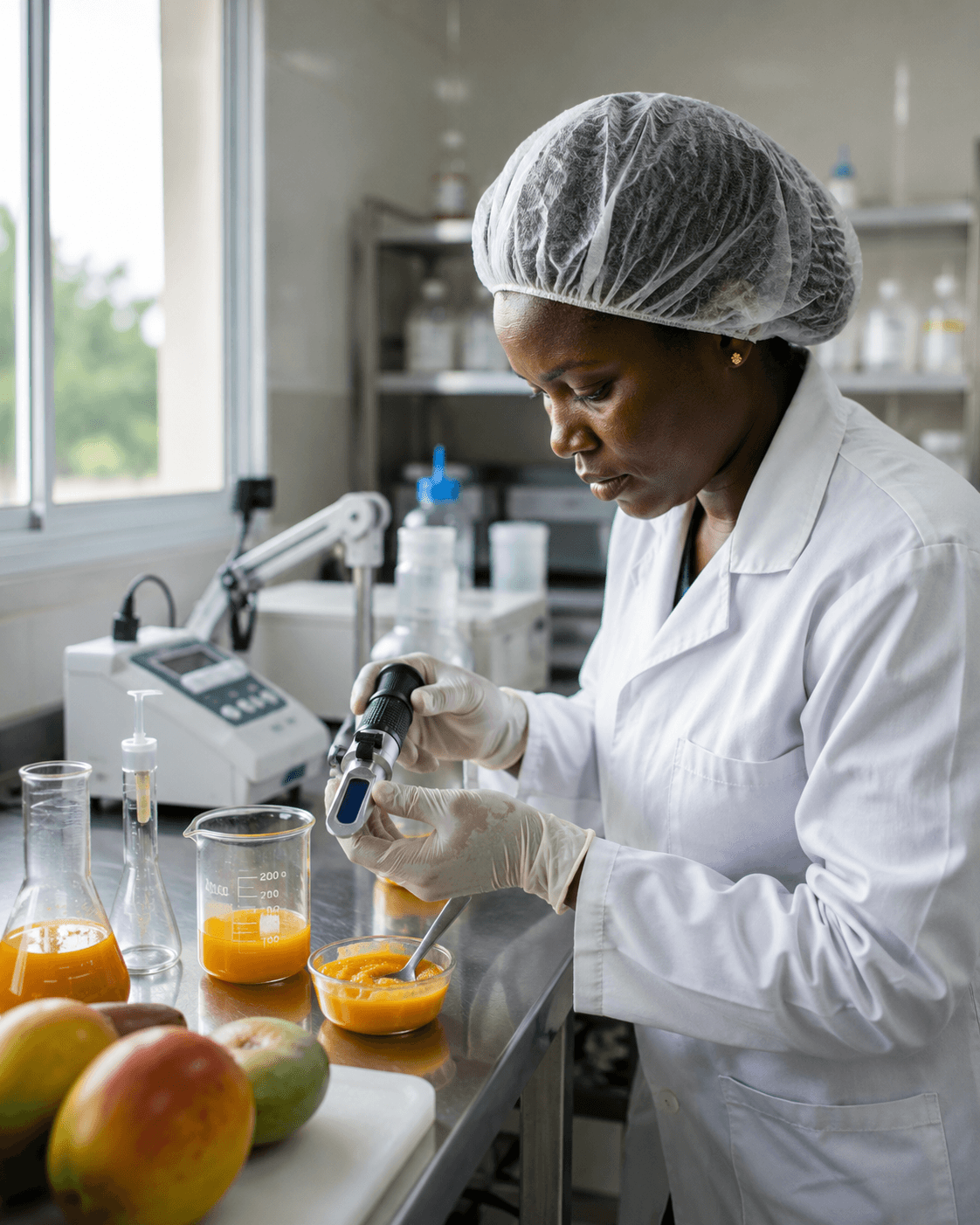 Photograph — quality control, laboratory
Nothing is wasted: the fruit feeds three lines, and the kernel itself becomes an ingredient.
Gentle pressing of the ripe fruit, flash pasteurisation, aseptic filling. No concentration, no reconstitution.
Peeling, pitting, cutting, then gentle low-temperature drying. No added sugar, no sulphites.
Valorisation of the kernel almond — a by-product of cutting — into an edible and cosmetic fat.
Specifications, traceability protocol, capacities, campaign schedule: the export team provides the information you need.